

Thanks to Catherine Priggs, Assistant Headteacher T&L, Dr Challoner’s Grammar School and member of HA Secondary Committee for this week’s blogpost. In it Catherine explains how to work with senior leaders to ensure that they have the knowledge they need to support history teaching and subject leadership.
Curriculum leadership needs our attention. In the face of non-specialist teaching due to a recruitment and retention crisis, and some trust-wide policies being mandated in all classrooms, subject leaders must shield subjects from slipping into genericism (1). But subject leaders can’t do this alone. Academic disciplines drive pupils’ interaction with their studies at subject-level but subjects exist within the whole school. It is true that middle leaders drive whole-school priorities and values in the classroom. To be effective, senior leaders must therefore understand what subjects are, and what they are not. If we truly want to preserve, nurture and develop history as a discipline, it is also senior curriculum leadership that needs our attention.
I’m sure we can all recall whole-school practice which has threatened to distort our delivery of history. To name one, a mandated use of GCSE style assessment at Key Stage Three, for example, will lead to many issues. A Key Stage 3 curriculum should ideally develop foundational knowledge which pupils specialise in in later studies. But, if applied at Key Stage 3, GCSE-style assessment would force a narrowing of the curriculum.
Generic policies such as this can result in subject leaders going on the offensive, fighting to protect the integrity of their subject. In my experience this only furthers a disconnect between subjects and the whole school. What I will explore in this post is how to develop meaningful relationships with senior leaders in order to preserve the authenticity of subjects.
Senior leaders have a responsibility to lead curriculum across the school. Senior leaders need to know what makes subjects tick. They need to understand that subject leaders of history lead history, they are not subject leaders of intervention or retrieval practice. Whilst whole school frameworks are necessary, individual line management relationships need to be informed by the sometimes subtle and sometimes stark differences that define subjects.
But is this realistic? Can and should senior leadership teams really develop a meaningful interaction with each subject they line manage? I absolutely think so. Below are five ways in which we might go about trying to lay the groundwork for curriculum harmony.
- Start by thinking about what the senior leadership team need to know about history.
Senior leaders would benefit from knowing:
- How a history curriculum works (and how it doesn’t!). For example:
- how one enquiry informs another;
- how lessons or enquiries are designed to prepare pupils for future learning;
- how prior learning is disrupted by new learning;
- and how pupils progress in their disciplinary and substantive knowledge.
I’m not suggesting line managers of history teams should understand this on a micro level, but they should understand the rationale behind sequencing and assessment in history curricula.
- Whether the curriculum is implemented with fidelity to the final intention. Subject leaders should be able to articulate what has underpinned topic selection and sequencing, how the curriculum manages the interplay between disciplinary and substantive concepts, and the mental timelines that are being built throughout the curriculum. If line managers come some way to understanding this they will have some sense of how curricular intent manifests itself in a history lesson.
- Provide your line manager with questions to support line management conversations.
Mary Myatt argues senior leaders need to trust subject leaders as specialists and have detailed conversations with them about what is being taught and the rationale for it being included (2). This should not be ad hoc and is an important aspect of quality assurance of a school’s curriculum.
Directing the flow of line management time will support subject leaders with subject-specific curriculum development; it will also build the curricular awareness of senior leaders (3). There is value in senior leaders having a shared language to probe subject leaders’ curricular thinking, but we need to consider how shared language can avoid becoming an over-simplified proxy. Figure 1 provides an example of helpful questions that could be used within line management meetings (4).
Figure 1
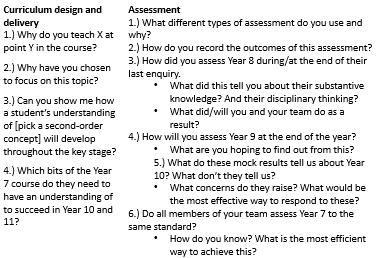
For some, this might seem like a step too far; line management meetings can be highly prescriptive which challenges a subject leader’s ability to direct their flow. However, Ofsted’s most recent Education Inspection Framework (2019) placed a firm emphasis on curriculum, one which requires subject leaders to be able to answer questions of this nature (if that stick needs to be resorted to!).
If you’d like to think further about how to structure these conversations then Christine Counsell’s chapter in The researchED guide to the curriculum and Ashbee (2021) are both fantastic places to go (5).
- Tell senior leaders what they should expect to see in lessons.
Figure 2 shows a series of questions from a device produced by Grace Healy (currently Curriculum Lead at David Ross Education Trust). Healy asked her geography subject leaders to answer these questions to show senior leaders what they should expect to see in lessons. The completed device provides a snapshot into the narrative of geography education and aims to help senior leaders see when teaching is effective, and when it isn’t.
Figure 2
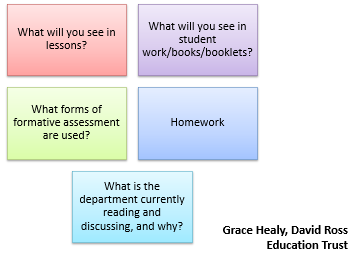
A copy of this device can be created from a template linked here.
- Tell senior leaders how assessment works.
Assessment is critical – it’s where things can start to fall apart. Assessment should not be considered separately to curriculum – the two should be deliberately interwoven. As Michael Fordham argued, “the curriculum is the progression model”, and assessment is not, therefore, an adjunct to curriculum (6). But assessment is sometimes separated from curriculum as a response to whole-school approaches to assessment.
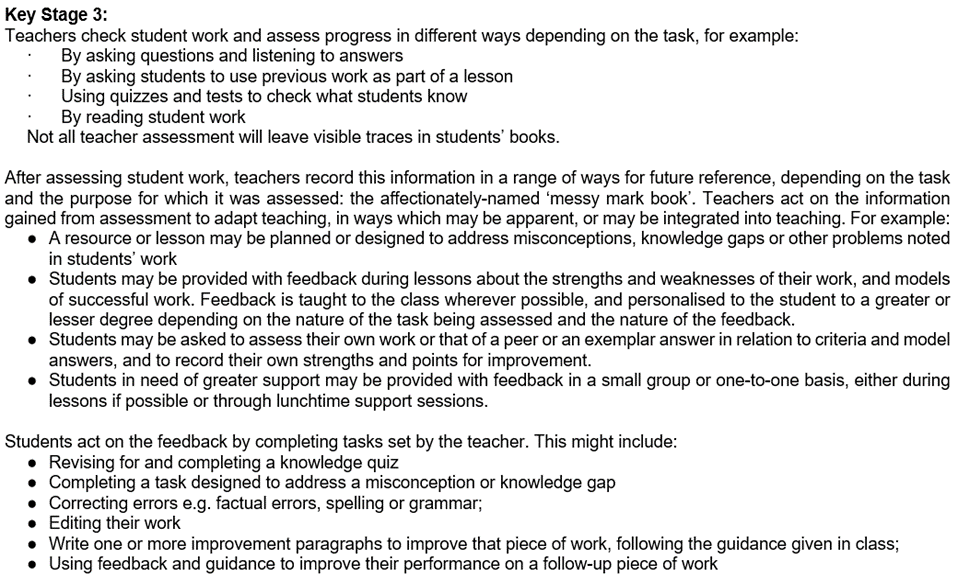
Proactivity is key. Before subject leaders are told how to assess, they should consider telling their line manager what assessment looks like in their department. Figure 3 is an extract from a document Elizabeth Carr put together to do just this. Carr used this document to preempt misunderstandings of subject nuances, which could have resulted in bizarre whole-school systems being applied to a subject.
Figure 3
- Get your line manager reading!
Reading subject-specific material may seem like a tall order for the busy senior leader. But this is what senior curriculum leadership is. Reading material recommended here will help senior leaders to support your team, whilst helping you to preempt some of the potential issues of having a non-subject specialist as a line manager.
A good starting point is undoubtedly Huh: Curriculum conversations between subject and senior leaders, in which Mary Myatt and John Tomsett discuss subjects with subject experts. In the history chapter, David Hibbert and I discuss topics like the building blocks of a Key Stage 3 curriculum, what it means to think historically, and the status of knowledge. The style is very colloquial (the chapters are essentially transcripts of conversations we had) so it’s a very accessible place to start, and the subject chapters are prefaced by some great chapters on leading curriculum development.
Ruth Ashbee’s Curriculum: Theory, culture and the subject specialisms is another great place to go. Ashbee sets out some of the principles of curriculum theory and provides practical strategies for the implementation of a knowledge-based curriculum.
And for a bit more of a challenge:
- Debates in History Teaching. This book will provide them with an understanding of the types of things history teachers are debating. Reading some of this book will help senior leaders to understand, amongst other things, the nature of curricular progression in history, what assessment might look like, and how knowledge is constructed.
- MasterClass in history education. The book starts with a series of chapters presenting practitioner research – this is followed by academics’ reflections on the themes emerging from the teacher-research, and then further reflection on themes running through the book from the three editors.
I hope this post has helped to generate some thoughts, or crystallised your thinking on how to enable your subject and team to thrive within the whole school whilst contributing to it. If you’d like further support please see here for a link to a course I run with Elizabeth Carr, David Hibbert, and Hugh Richards, designed specifically to support line managers in the ways I have discussed.
References:
1) For further thoughts on this see: https://thedignityofthethingblog.wordpress.com/2016/01/11/genericisms-children/
2) Myatt, M. (2020) Curriculum: Gallimaufry to coherence. S.l.: John Catt Educational Ltd., p.137.
3) This is advocated in the concluding chapter of Huh: Curriculum conversations between subject and senior leaders – see references.
4) Taken from resources created for the Historical Association’s short course ‘Secondary History: A Masterclass for Senior Leaders’.
5) See pp.59-62 and p.82 in Ashbee, R. (2021) Curriculum: Theory, culture and the subject specialisms. London: Routledge.
6) Fordham, M. (2020) What did I mean by ‘the curriculum is the progression model’?. Available at: https://clioetcetera.com/2020/02/08/what-did-i-mean-by-the-curriculum-is-the-progression-model/ (Accessed: 19 May 2023)
Further reading:
Ashbee, R. (2021) Curriculum: Theory, culture and the subject specialisms. London: Routledge.
Counsell, C., ‘Better Conversations with Subject Leaders: How Secondary Senior Leaders Can See a Curriculum More Clearly’, in Sealy, C. and Bennett, T. (eds.) (2020) The researched guide to the curriculum: An evidence – informed guide for teachers. Melton, Woodbridge, UK: John Catt Educational Ltd.
Counsell, C. et al. (eds.) (2016) Masterclass in history education: Transforming teaching and learning. New York: Bloomsbury Academic.
Davies, I. (ed.) (2017) Debates in history teaching. London: Routledge, Taylor & Francis Group.
Fordham, M. (2020) What did I mean by ‘the curriculum is the progression model’?. Available at: https://clioetcetera.com/2020/02/08/what-did-i-mean-by-the-curriculum-is-the-progression-model/ (Accessed: 19 May 2023).
Myatt, M. (2020) Curriculum: Gallimaufry to coherence. S.l.: John Catt Educational Ltd. Myatt, M. and Tomsett, J. (2021) Huh: Curriculum conversations between subject and senior leaders. Melton, Woodbridge: John Catt Educational Ltd.
 OBHD
OBHD 