

This blog post has been written by Sarah Nathaniel, Public Engagement Coordinator (South East) and Education Officer for the Commonwealth War Graves Commission (CWGC) and relates to a taught session resource enabling teachers to make the First World War a truly global war for pupils.
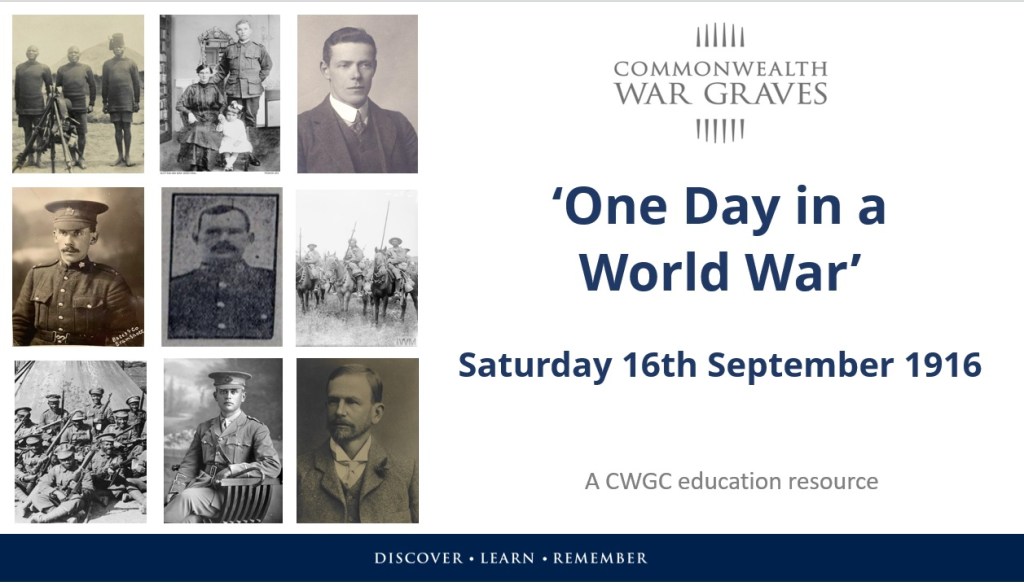
The Commonwealth War Graves Commission commemorate more than 1.7 million service men and women of Commonwealth forces who died in the two world wars, ensuring they will never be forgotten.
Funded by the governments of Australia, Canada, India, New Zealand, South Africa, and the United Kingdom, we are a truly global organisation. We care for graves, cemeteries and memorials at over 23,000 locations in more than 150 countries and territories around the world.
Education forms a vital part of our ongoing commitment to sharing the stories of these casualties we commemorate and as we move further away from the living memory of those conflicts, this promise becomes even more important. How best to keep those stories alive? How do we try to learn the lessons of history and deliver a message of the devastating consequences of war on families and communities?
Understanding the scale and human impact of the First World War can be challenging for students, especially when classroom study often centres on the Western Front. One Day in a World War, a classroom resource from the Commonwealth War Graves Commission (CWGC), offers a powerful way to broaden that perspective. Using real CWGC data, students explore what was happening across the world on just one day of the conflict: Saturday 16 September 1916. This uses a day during the Battle of the Somme, a popular classroom topic, to help students move from a familiar, narrow narrative to a truly global understanding of the war- while still grounding their learning in individual human stories.
How the Resource Works in the Classroom
This resource is designed for students aged 11–14 and is easily delivered within a one-hour lesson. The aim of One Day in a World War is to help learners explore not just who was fighting but where these individuals came from, where they were dying and how far-reaching the conflict was beyond the Western Front.
The resource is focused around a central enquiry question: What can we learn from CWGC records about the extent to which this was a ‘world war’? It asks students to interrogate data from the CWGC database to explore this question.
The lesson works particularly well after studying the Battle of the Somme or any Western Front topic, offering an ideal next step into a wider global context. All data, story cards and a teacher PowerPoint deck are available to download from our website.
Starter Activity – Expanding the Narrative
The resource begins with a whole-class discussion designed to explore students’ existing assumptions about the First World War. What words, images or stories do they associate with it? How representative are these of a global conflict?
This initial discussion is then challenged through the use of the Left Behind animation, which explores the experiences of the Carrier Corps in East Africa. Created collaboratively by students in London and Nairobi, this short animation presents a powerful counterpoint to Western Front‑focused narratives and opens the door to broader enquiry.
Main Activity – Investigating the Data
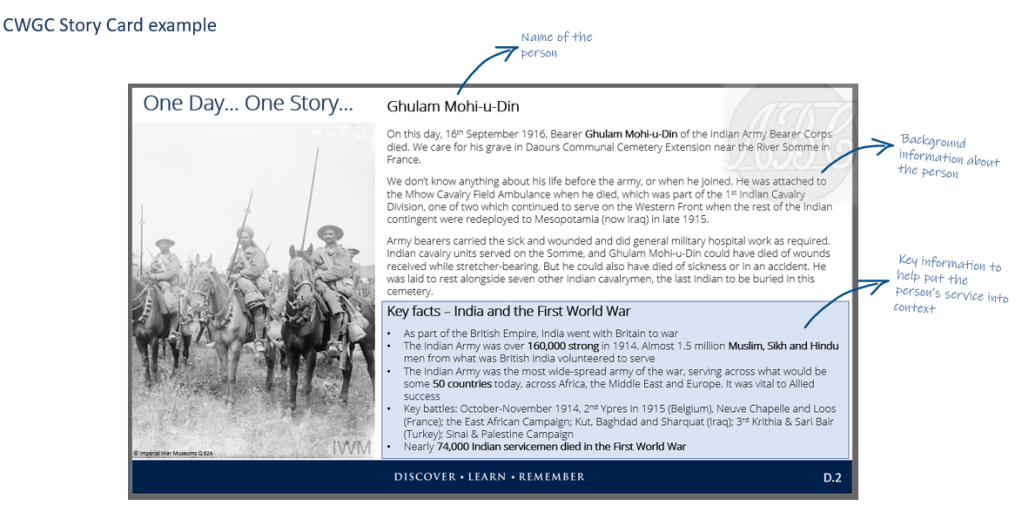
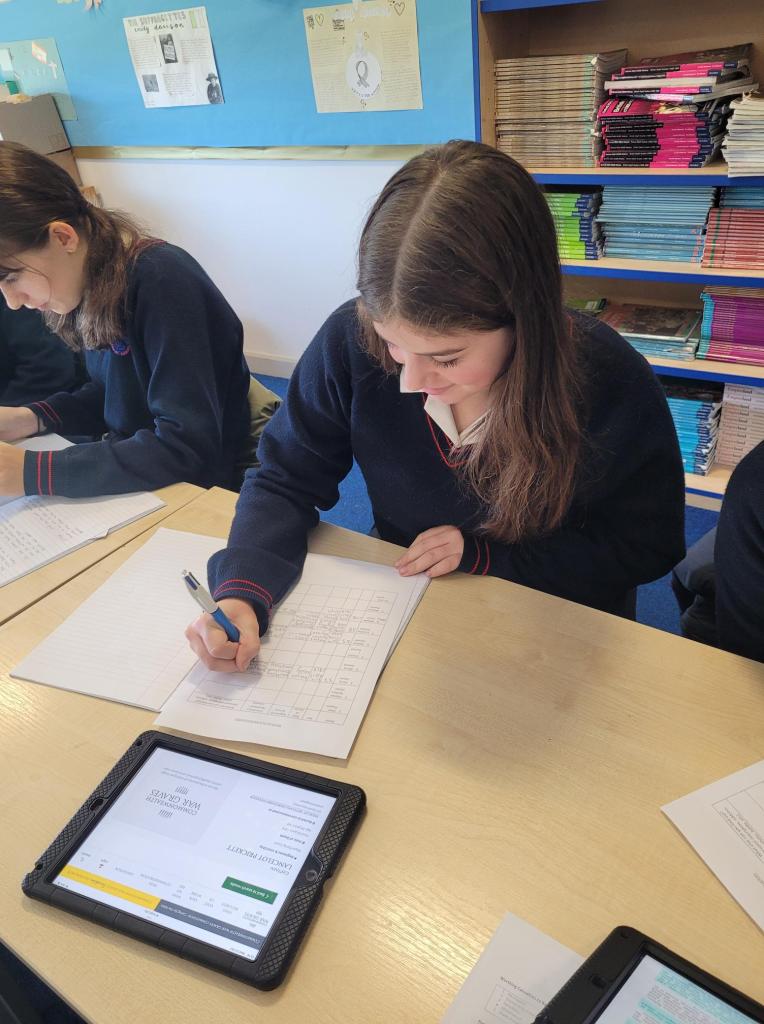
Following this starter activity, students work in pairs or small groups to begin looking at our records. Armed with a data set and a story card, learners are asked to explore groups of individuals who died on the 16th September 1916 and look in detail at where they came from, where in the world they are commemorated and identify patterns. The story card provides a personal example of one of those casualties and aims to give a detailed biography and contextual information for that individual to personalise the data. Themes covered are as follows: the full range of services, including Merchant Navy, casualties from across the former Empire including Undivided India and the West Indies and fighting in East Africa.
Pairs and groups are then asked to feedback findings and can add to a collaborative map, giving a powerful visual of the global nature of the conflict. Evidence gathered is used to write a final concluding paragraph answering the enquiry question and the teacher can guide a discussion on the findings. Extension activities are also included within the resource should a deeper dive into this topic be preferred.
This resource is just one of a range of free high-quality war resources the CWGC produce for all ages. There is a similar resource centred around D-Day, as well as resources covering topics such as Black History Month, Women in the Second World War, Medicine on the Western Front, Poetry, and Remembrance resources. We also bring together teaching aids, cemetery guides and interpretative material that supports young people in exploring their local CWGC heritage.
These education resources for use in the classroom, in a cemetery or on battlefield visits can be found here: World War Resources for Learning: Guides and Research | CWGC
If you would like to keep up to date with all education news from the CWGC, you can sign up for our Education newsletter here: Sign up to the Commonwealth War Graves Education Mailing List Today – CWGC
If you have any questions or would like to discuss our educational offering, please do email us at: education@cwgc.org
 OBHD
OBHD 