

Thanks to Martyn Bajkowski of Pleckgate HS and HA Secondary Committee for this blogpost. Martyn reports on the work he, and his department, have been doing to improve their KS3 assessment.
Like many of you I have carefully considered over recent years what I wanted our approach at assessment to be at KS3 in our department. Following my session at the HA Conference this May I have received requests for people not there for me to explain what our rationale is for assessment at KS3 and what we do at Pleckgate. I’ve tried to separate it out into our rationale for doing it, how we did it and the impact it has had below.
Rationale
When I sat down with my department to discuss assessment we wanted to be clear on what the purpose of our assessment was. We came up with the following:
● Assessment should inform us as classroom teachers about how well our last sequence of learning has landed with our pupils.
● By how well it is landed we mean both their substantive knowledge, understanding of key historical concepts and how well they can express that knowledge through second order concepts.
● We also wanted to assess how well that knowledge had been attached to previous knowledge they had been taught.
● We wanted to be able to provide accurate feedback that moved pupils on.
● We wanted to be able to visually see to what extent our curriculum was a progression model
● We needed to be able to sort our pupils, for their age and stage, into groups so that we can report to parents.
Ultimately what we wanted to create was a system that gave us knowledge about how well our intent was landing, allied with other QA measures which would help to inform department CPD in addition to reshaping and refining the intent.
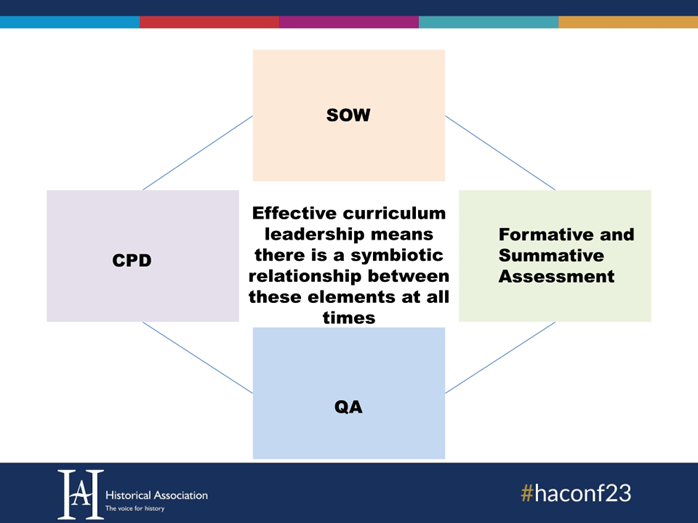
Where assessment has failed to deliver this in the past is connected to the bullets point about reporting to parents and reporting accurately. The need to report ‘accurately’ on the progress of our pupils is where I believe wehave gone wrong in assessment practice in the past. We have misinterpreted the word ‘accurately’ to mean that every pupil needs a mark on each question and an overall mark on a paper. And by doing so it has led to this scenario when I have come to analyse results.
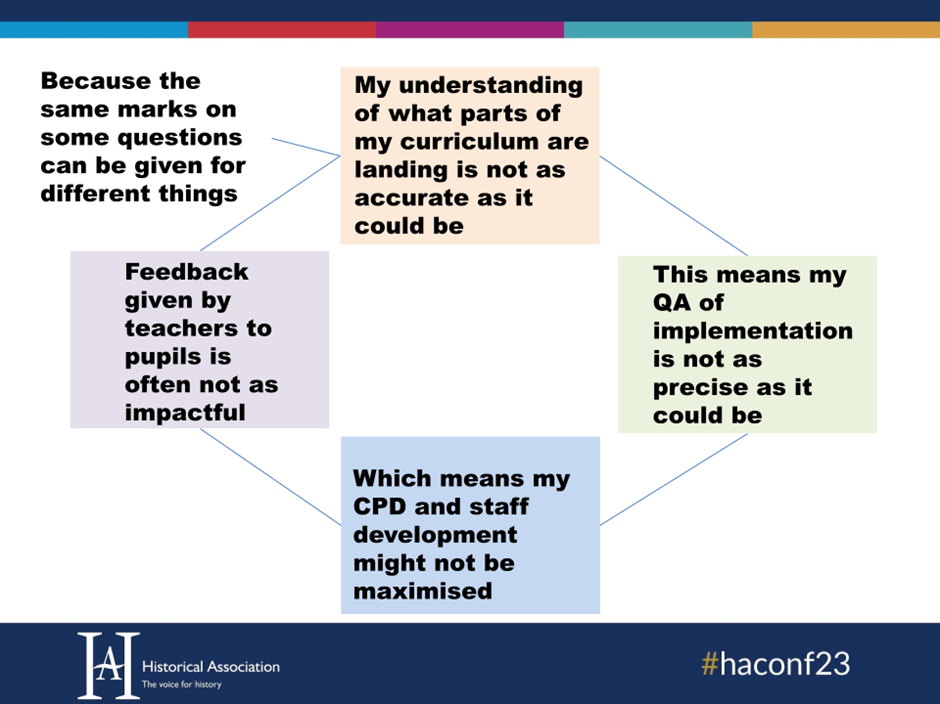
We came to the conclusion that maybe marks are getting in the way of both effective feedback to pupils and in our understanding of how the curriculum was landing.
Set Up
In order for assessment to work well we decided that there needed to be some key points established.
● A shared understanding of what progression in history is
● A clarity over what the intent in our curriculum is
● An exam that tested recently gained substantive knowledge, developing understanding of key concepts, chronology and source analysis
● An exam that gave an opportunity to demonstrate knowledge from the whole of KS3
● An exam that could illustrate progression over time
● An understanding of what outstanding, very good, good and developing history looks like for the appropriate age and stage of the pupil
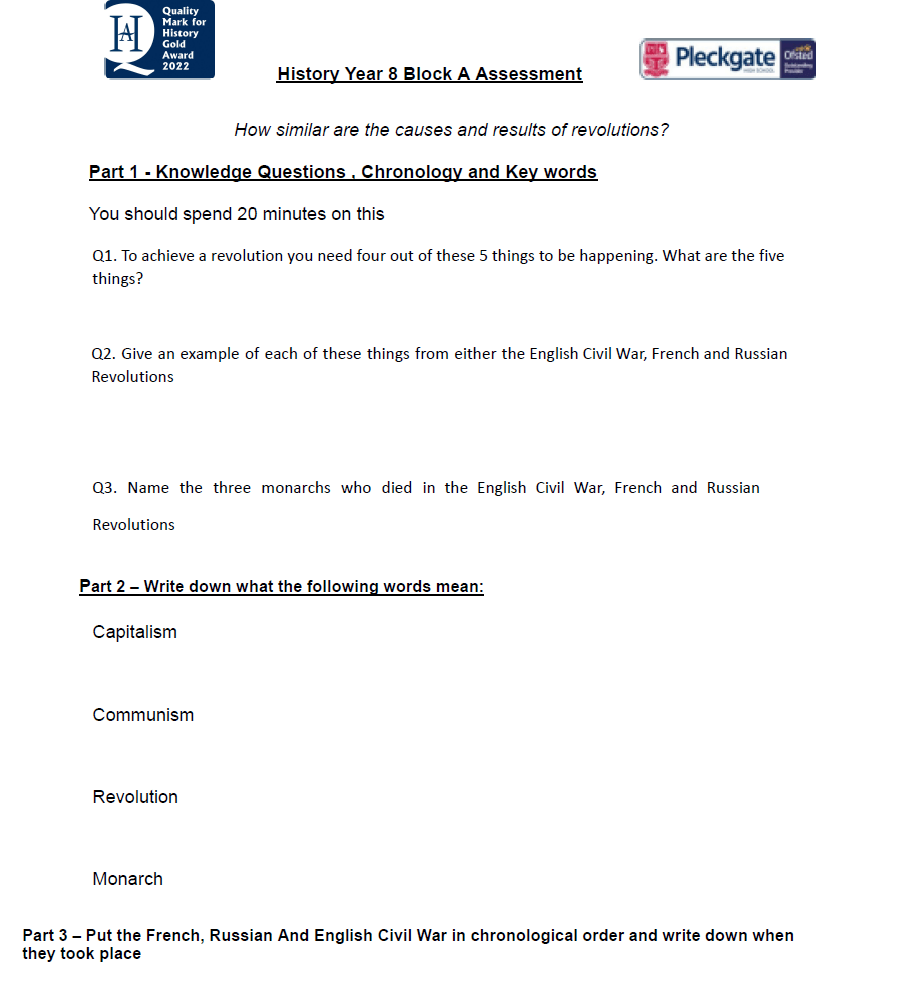
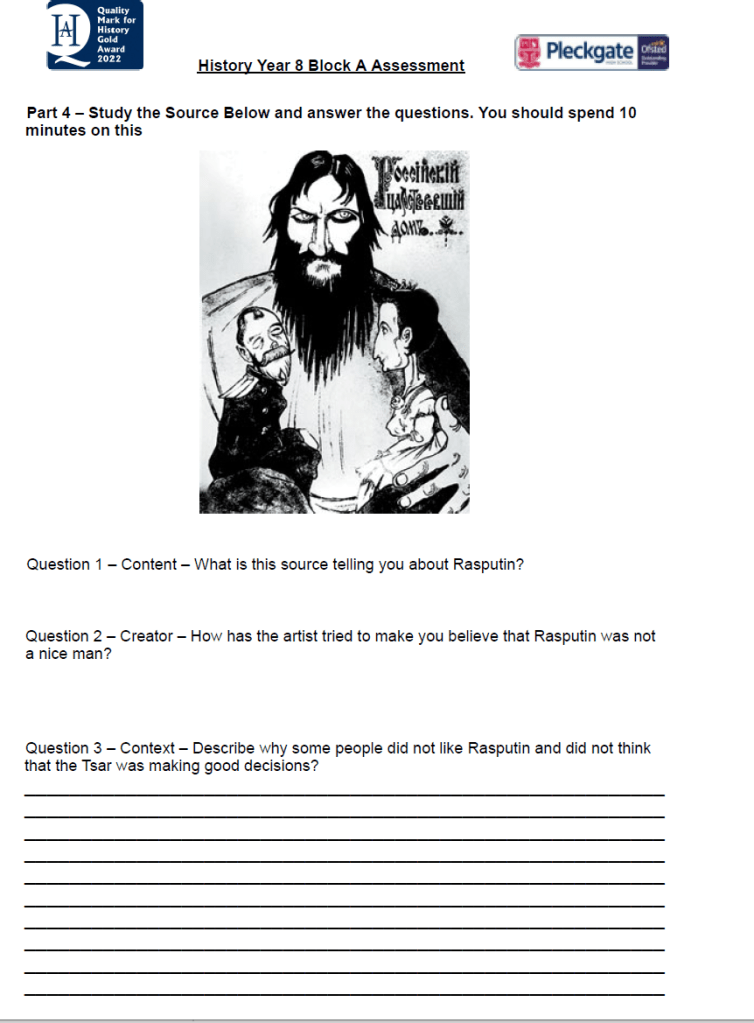
For the sake of brevity within this blog I Imagine that you and your departments have definitely got the first two bullet points nailed. Our exams, again probably similar to yours, ask pupils from simple knowledge recall based on their last sequence of learning with a couple of questions thrown in from a previous sequence. We then have a concept section where they have to articulate what their understanding of say capitalism, communism, protest and power are. We have chosen key concepts woven into our curriculum and they always appear on at least two exams. This is important for us as this is not a mix and match activity, but a chance for them to demonstrate their (hopefully) increasing understanding of the concept based on newly acquired contextual knowledge. We have a source question (using Hugh Richard’s ‘Content, Creator and Context’ framework) and these sources are tiered in difficulty as they progress through KS3. We use artefacts/paintings in Year 7, propaganda in Year 8 and political satire in Year 9. Not because one type of source is easier or harder than the other, but to ensure the range of sources we use. Again I am sure that a lot of departments do something similar.
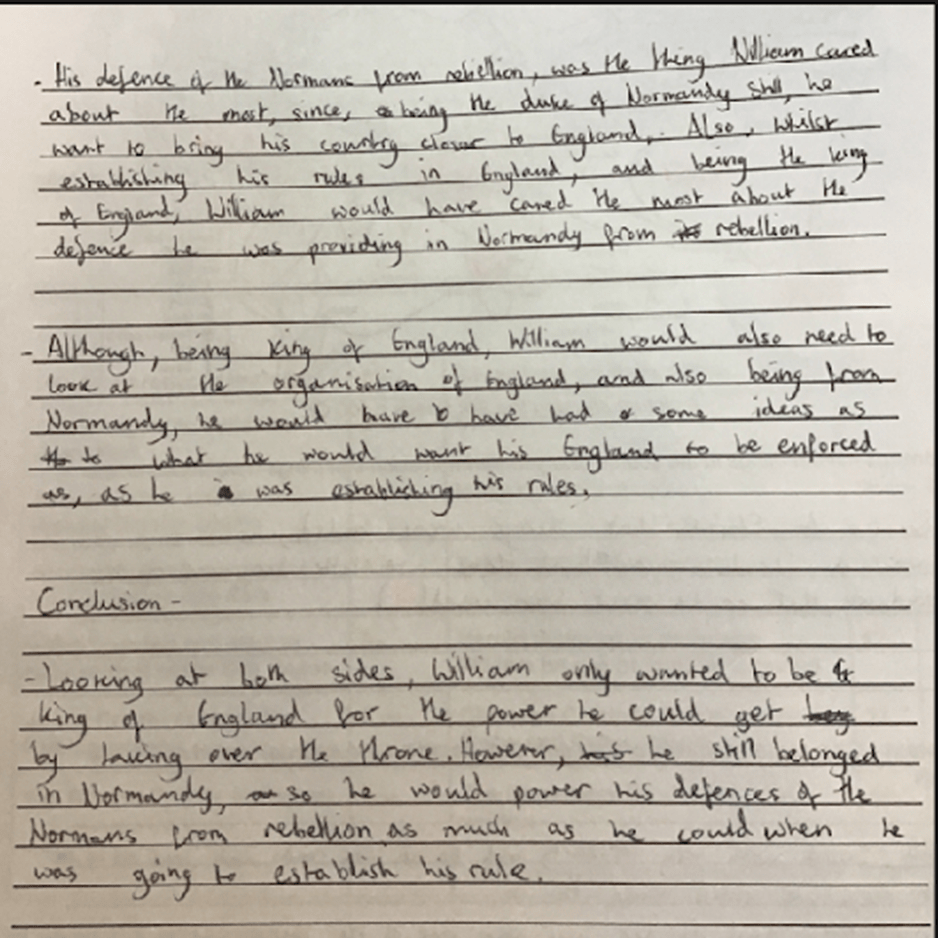
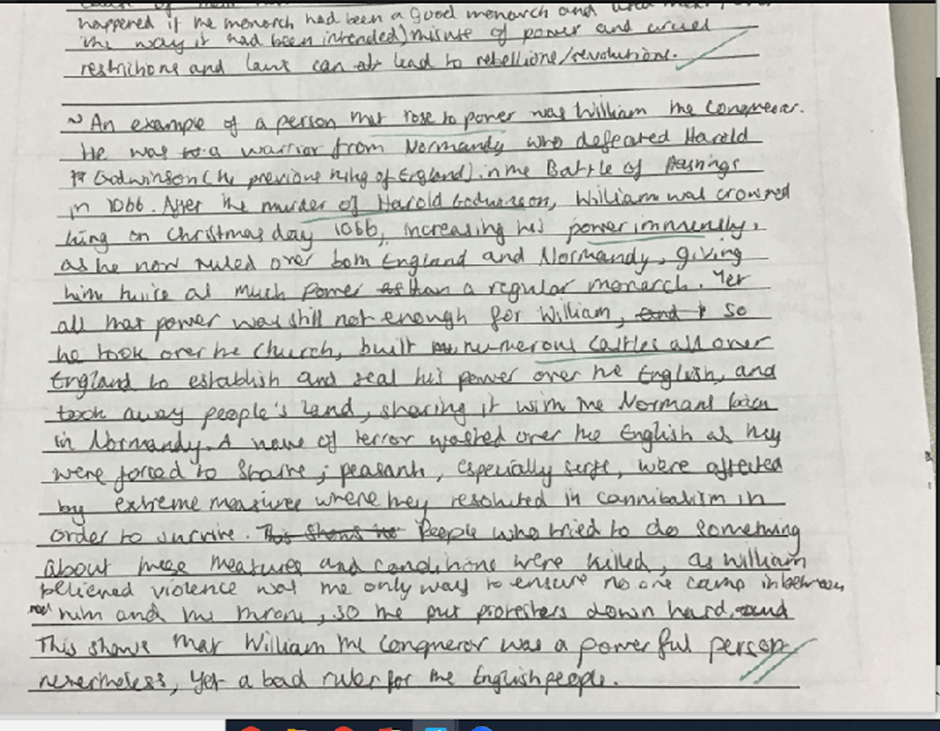
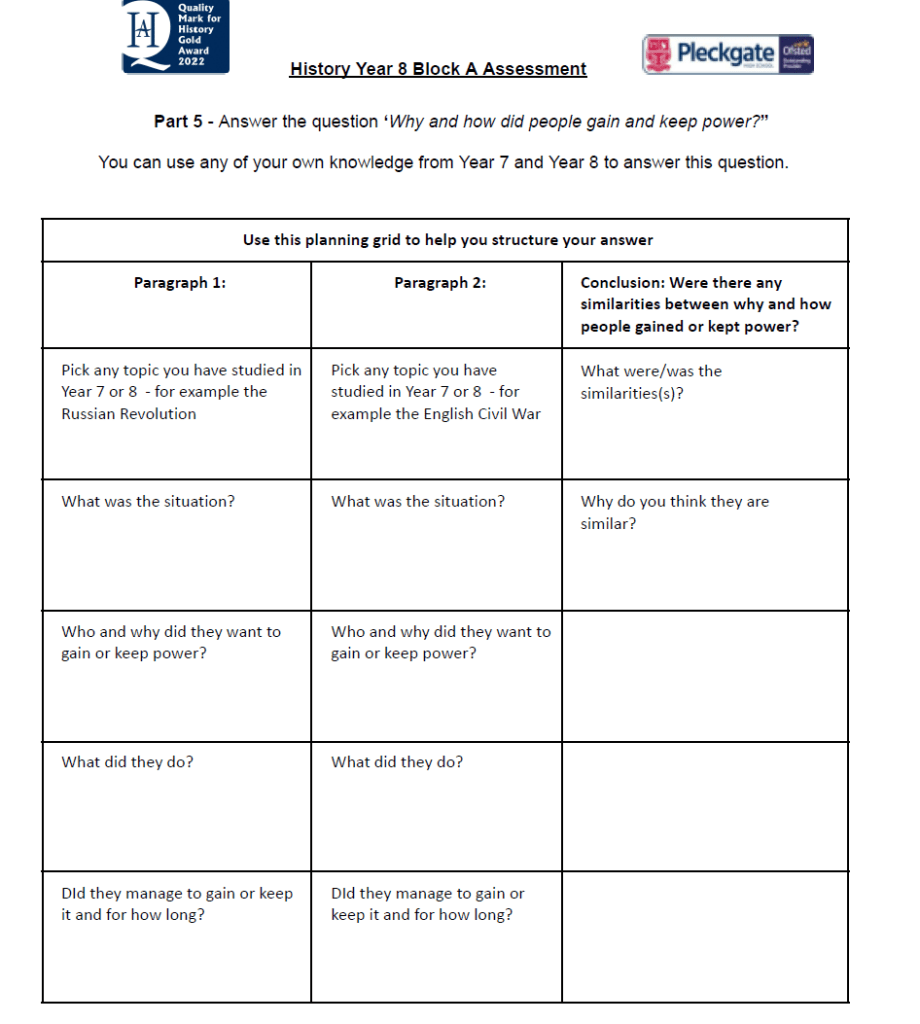
Where we probably differ from most is in the extended writing section of our exams. Based on how we have sequenced our curriculum and the themes that are developed within lesson sequences, we have been able to ask Year 7, 8 and 9 the same extended essay question at the same point in each year. For example in November of Year 7, 8 and 9 they all answered the question ‘How did people gain and keep power?’. By answering the same question you can directly see their progress in gaining historical knowledge as they go through KS3. The essay also gives pupils an opportunity to showcase their understanding of how the threads that are interwoven throughout the curriculum fit together.
For example In Year 7 Parissa spoke about the Norman Conquest like this:
In Year 8 she was able to articulate the Conquest in a much more sophisticated way.
How do we actually mark it then – if we don’t give marks?
Over the past few years we have done a lot of work on comparative judgement, particularly at different stages of Year 7, 8 and 9. From there we have developed a collective guide about what we call ‘Mastery, Secure, Developing and Emerging’ look like.
In order to sort pupils into a group so that we can report to SLT and parents we take a view of the entire paper and decide which group (Mastery, Secure, Developing or Emerging) the pupil is in and then decide whether this pupil is at the top, middle or bottom of this level.
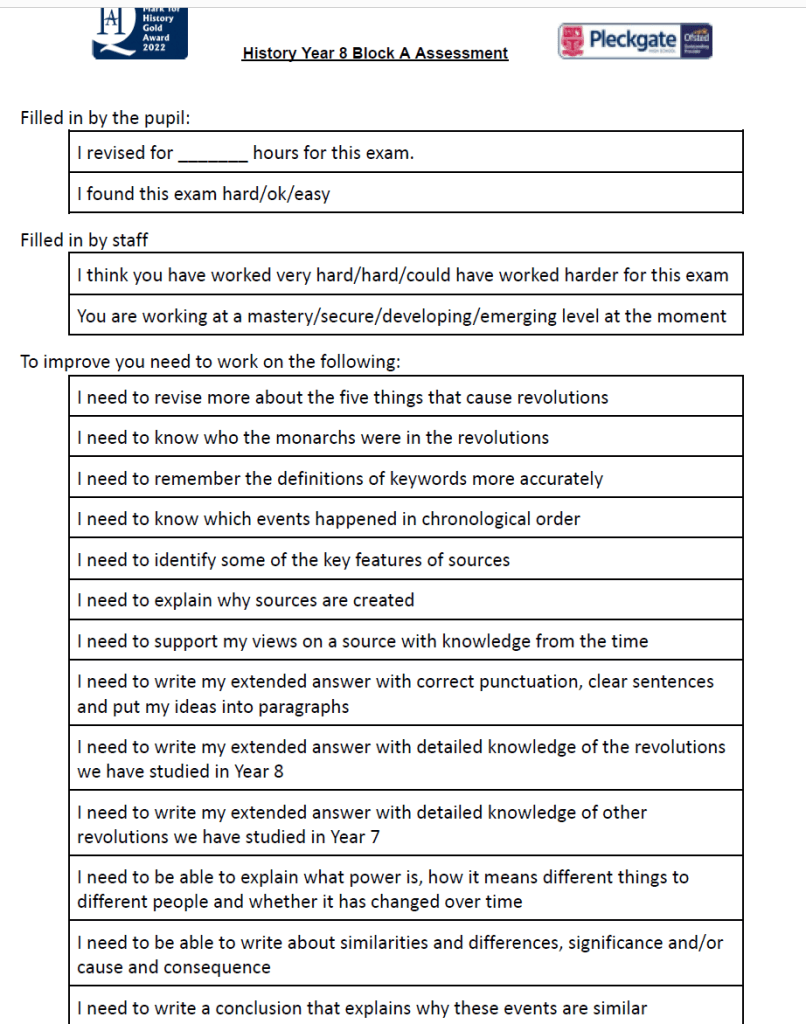
We have printed out next steps for the pupils and tick the 3 most pertinent to their improvement and record this on a spreadsheet.
Although this might seem very subjective and prone to error, when I tried this at the Historical Association with 20 delegates on three different scripts, everyone was unanimous in the ranking and grading they gave.
I then compile a report to the department which shows the distribution of grades across the year groups and within classes.
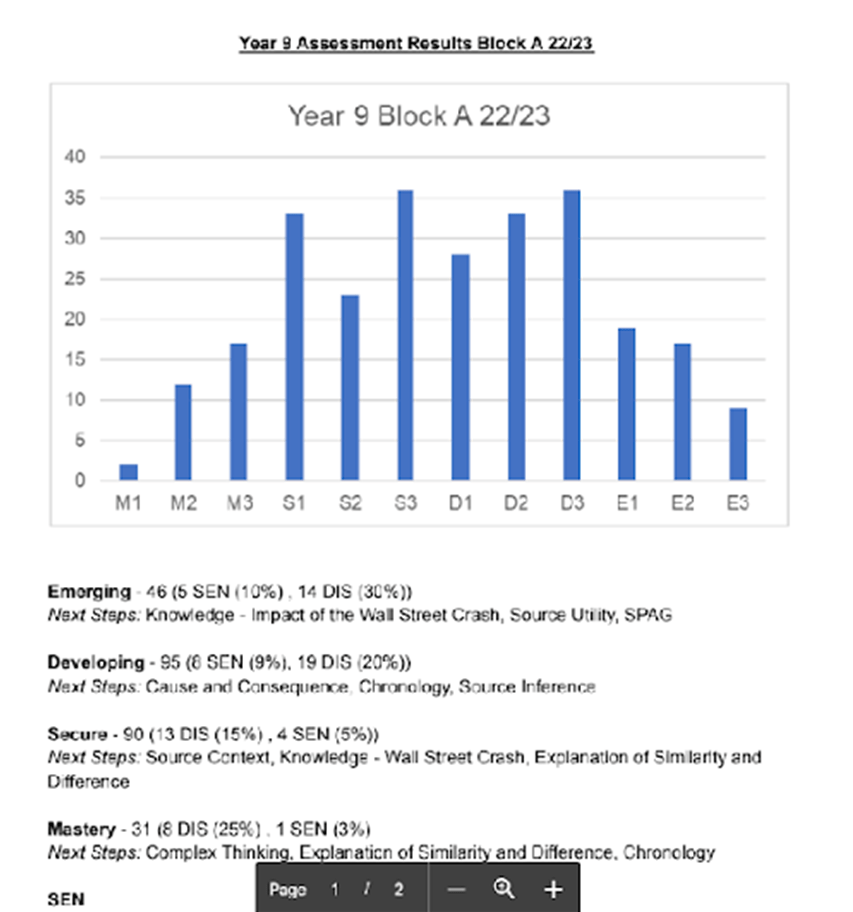
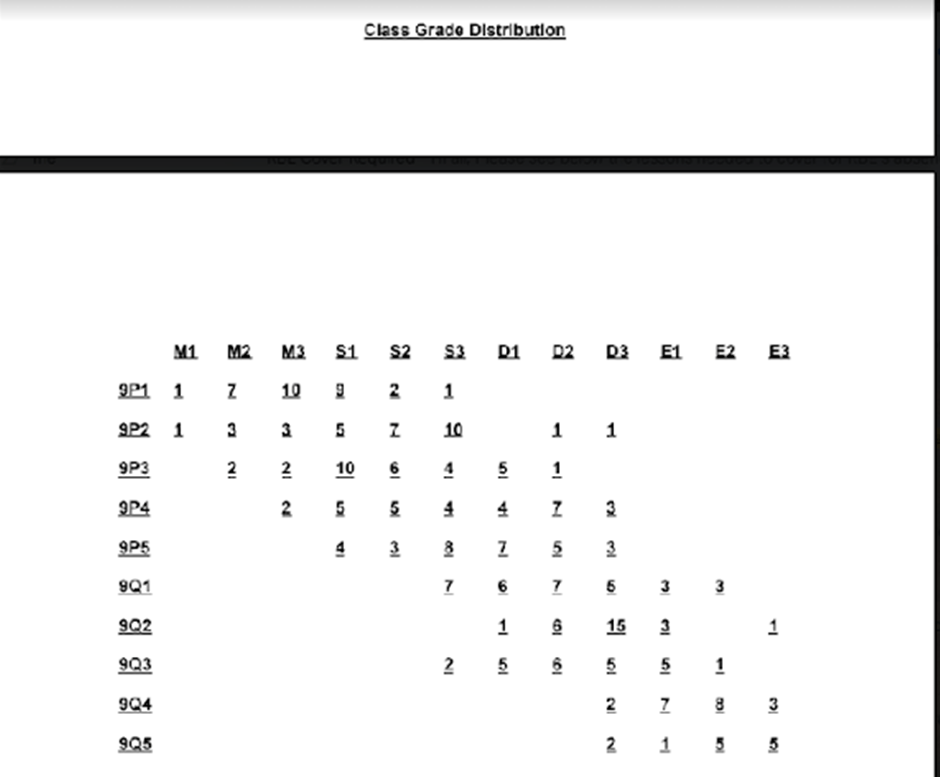
Does it work?
In short, yes! We have found that pupils have really embraced these exams and we can clearly see evidence of progression across the curriculum. We photograph emails and keep them on Google Classroom and it is really nice for the pupil to be able to look back on their work from 6, 12 or 24 months ago and see their development.
We have also been able to use it to better inform our intent and implementation. In our November exam this academic year we noticed a lot of pupils were getting a next step related to their source work. This was then followed up by a CPD where we looked at our books and the work we were producing and recognised an area of our curriculum that was not landing. As a result we then used CPD to go back over how we want to teach source analysis and replanned our forthcoming SOW to make sure that pupils had the contextual knowledge and understanding of how we wanted them to analyse source work. Their two subsequent exams have shown a clear improvement in this area.
Equally important in changing our pedagogy and approach, is that because pupils do not receive a mark, just next steps, it allows them to focus on this in their MAD TIme and have these as targets during the next sequence of lessons. This has seemed to work better than just a grade and a dismissal of their actual feedback if they are happy with the grade.
However, we have found that they need to know if we think they are on target or not, and so we do tell them upon return of their script about whether they are below, meeting or above our expectations.
A sample copy of one our our assessments is below and please feel free to get in contact via Twitter if you would like any more information or just a general chat about assessment. @MrBajkowski
 OBHD
OBHD 
excellent research and practice
LikeLike
Thank you Toby.
LikeLike