Meanwhile, elsewhere – a great team effort!

Last summer my history team began the gargantuan task of revising our KS3 curriculum. When we had agreed bits I often shared our work on Twitter (I tweet under the stupid name @kenradical). I had posted our Year 7 overview one evening and Ben Walsh (@History_Ben) replied asking where the global history was. He was right, we had hardly any. The next day I went back … Continue reading Meanwhile, elsewhere – a great team effort!


Rethinking how we teach about transatlantic slavery

As history teachers we put a great deal of time and effort into our work to make learning about the past enjoyable, meaningful and relevant. One our greatest challenges is in finding out what to do when we start teaching a topic that is without joy and indeed especially horrific. The Holocaust and transatlantic slavery are the two topics that best fit this description and … Continue reading Rethinking how we teach about transatlantic slavery

Later Middle Ages: Teaching Fellowship Resources

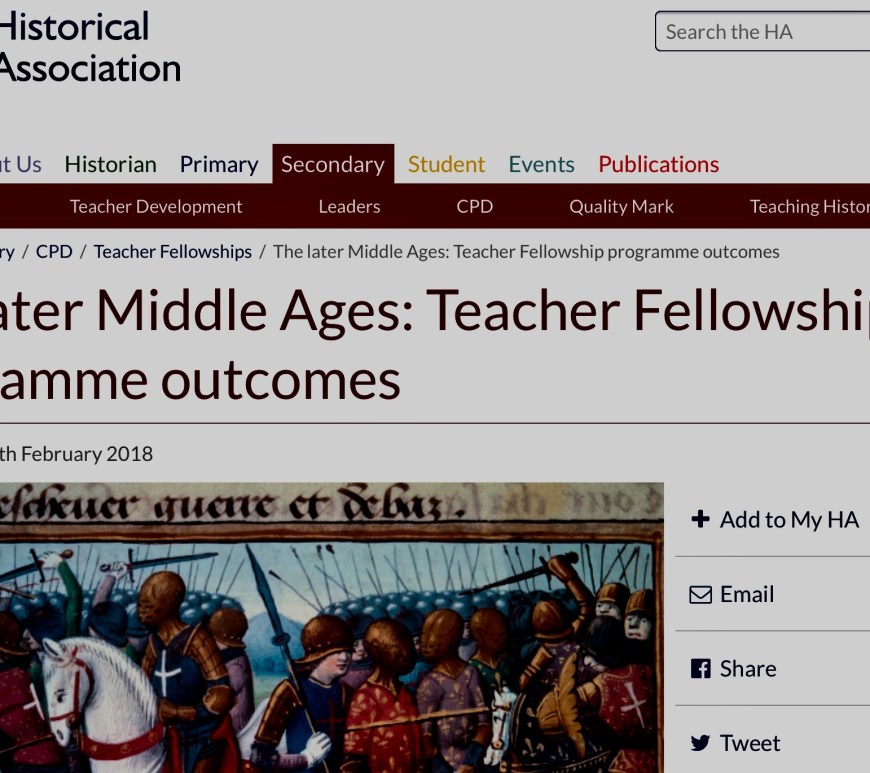
Hopefully you have managed to find the free copy of Teaching Medieval History that has been sent to your school. The online expanded version is Here. This has been made available thanks to Agincourt600. In 2015, they also granted the HA funding to start the first of its Teaching Fellowship programmes. A group of teachers spent an intensive weekend updating their subject knowledge with academics. They then … Continue reading Later Middle Ages: Teaching Fellowship Resources

Enquiry questions – the back story!

Over the weekend @LeeDonaghy asked history teachers on @Twitter if ‘an enquiry-focused history curriculum is a bit overrated for KS3’. It’s a good question. History-subject specialists learn from their subject-specialist ITT training that being able to construct an effective enquiry is a breakthrough moment in becoming a history teacher. But why? And how can we explain why? In response to @LeeDonaghy there followed a lengthy … Continue reading Enquiry questions – the back story!

Roleplay and recreation: sharing great Normans resources

Happy New Year to all of you! History teachers are a wonderful tribe and OneBigHistoryDepartment exists to connect history teachers not only to each other, but to the many years of great history teaching that have gone before. We are all too busy to reinvent wheels. We are all too clever to be gulled into thinking that the issues we face in the classroom are … Continue reading Roleplay and recreation: sharing great Normans resources

Substantive concepts: ‘Left-wing? Right-wing? Do you mean like in hockey, miss?’

This week a post to help teach tricky concepts at GCSE… Left-wing and right-wing are not easy concepts for GCSE students. Every year I make my students laugh by pacing from side-to-side of my classroom being the political positions on an imaginary political line from left to right. I am not good at impersonations, but I try to put politicians on the line in a … Continue reading Substantive concepts: ‘Left-wing? Right-wing? Do you mean like in hockey, miss?’

Knowledge to use sources as evidence

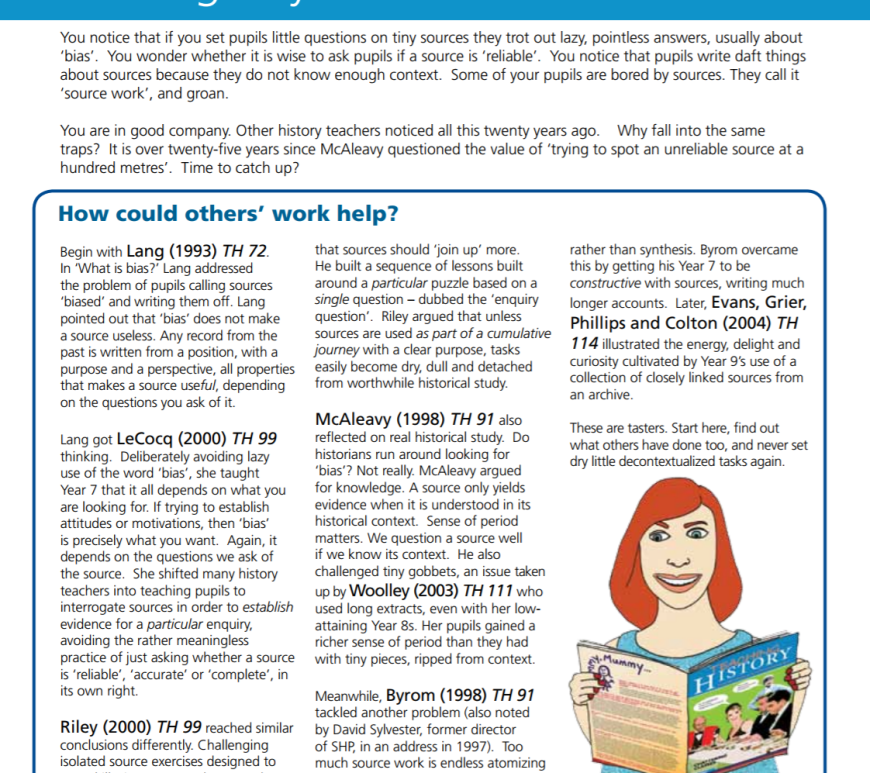
Recently we’ve been trying to shake up how we use sources in our History lessons. We decided that our Key Stage 3 students might be getting the impression that sources are just something History teachers use to get them curious about an enquiry question. There’s nothing at all wrong with using a fascinating picture, artefact or intriguing text to get students’ engaged. However, historians don’t … Continue reading Knowledge to use sources as evidence

Interpretations: Tell the artist why they are wrong!

As Helen wrote in her previous blog interpretations are a tricksy concept for students to understand, but due to the more rigorous demands of GCSE and A-Level one that we cannot ignore as we might have done in the past. At both GCSE and A-Level, the exams want our students to unpick interpretations using their contextual knowledge of the period. In essence they want students to … Continue reading Interpretations: Tell the artist why they are wrong!

Interpretations: ‘And then she waved a tea towel at us!’

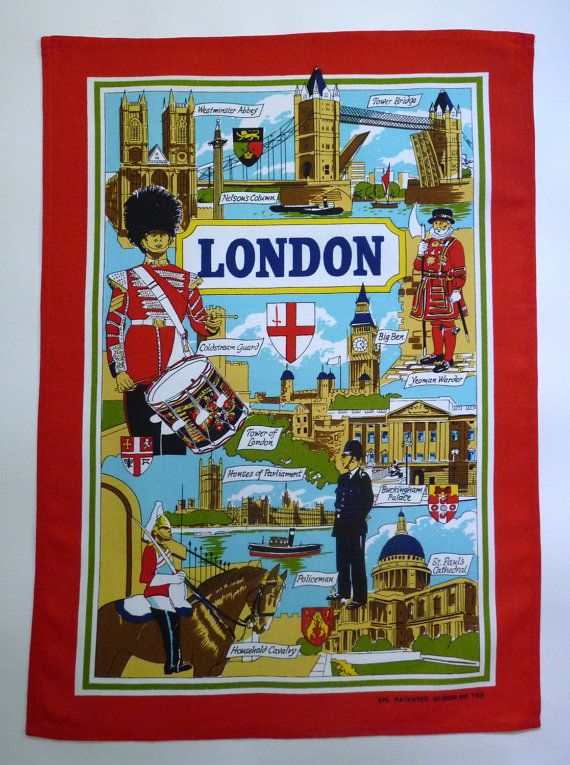
The conceptual thinking required to understand historical interpretations is challenging for many of students. It is a multi-facetted concept and we take an incremental approach to developing our students’ ability to understand and work with it. A tourist tea towel is an interpretation. We use one to get across the idea that an interpretation is a selection to present a particular perspective that is made … Continue reading Interpretations: ‘And then she waved a tea towel at us!’