

This blog post was written by Philip Arkinstall, Senior Lecturer in Education at the University of Gloucestershire and former Head of History and Politics.
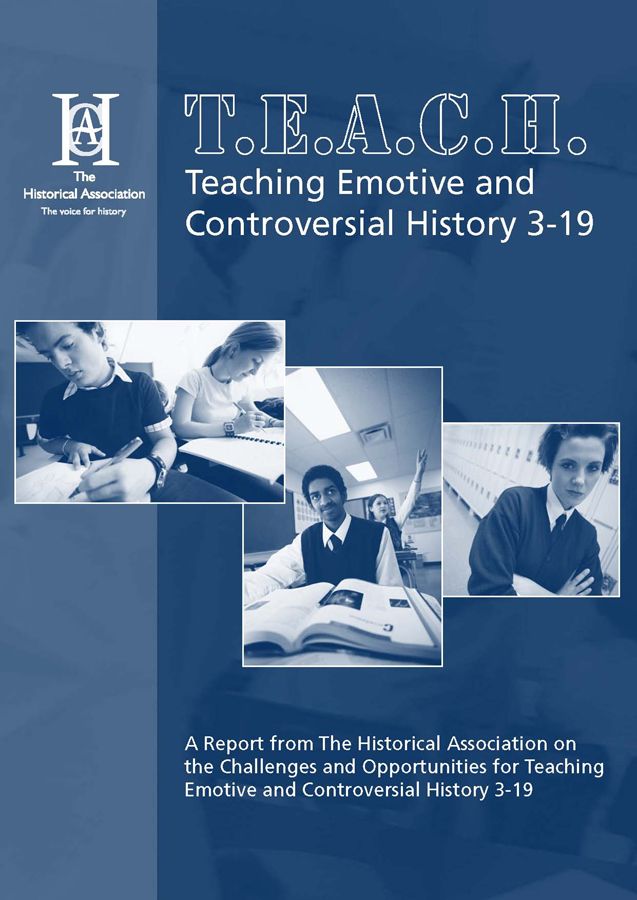
Having just started a new year with our trainee teachers, a topic of conversation that has come up has been about their confidence in answering problematic questions that emerge whilst teaching difficult histories. This post reflects on that starting point and signposts readers to the Historical Association’s Teaching Emotional and Controversial Histories (T.E.A.C.H.) Report from 2007.
The document is undergoing a refresh, and I have posted previously about finding ways to tackle controversial topics in the classroom. However, it is worth taking a look at what the T.E.A.C.H. report says. This will be the first in a series of blog posts exploring how history teachers are tackling difficult conversations and the resources they use.
It was produced in partnership with the Department for Education and Skills (DfES) in 2007 to explore how teachers effectively teach historical topics that may provoke a strong emotional response or are controversial due to issues of identity, injustice, ethnicity, religion, conflict or differing interpretations of the past.
You won’t be surprised by the types of issues that were being discussed, as they still remain pertinent today such as teaching The Holocaust, the Transatlantic Slave Trade, Israel and Palestine as core examples. However, the need to refer back to this document has become increasingly pressing. Some schools are facing a rise in misogyny, anti-immigration, misinformation and polarization of views. At the same time teachers are engaging with diverse identities and questions of contemporary relevance, while some pupils may no longer perceive these issues as relevant to their lives today.
There are multiple reasons which we can use to speculate over why such issues appear to be becoming more noticeable. However, I wanted to use this blog to start a conversation in the history community to identify what the issues are surrounding teaching such topics and also what wonderful things we, as practitioners, are doing.
Let us begin by defining the types of emotive and controversial history I am referring to and then look at what the T.E.A.C.H. report’s main findings suggest. From here, I shall then collect examples from the community and share future posts relating to strategies in the future. SO PLEASE DO GET INVOLVED WITH THE CONVERSATION.
Defining Controversy
Defining what constitutes an emotional or sensitive issue was widely debated back in 2007 and would be again today. I would argue that, as in 2007, it depends on when, where, and by whom the issue is being viewed. For example, some events or individuals caused strong emotions and disagreement when they occurred by may no longer have the same impact today. People living in different countries, communities, or social groups may feel differently about the same historical issue. Pupils’ reactions vary depending on their age and level of understanding. Oliver Cromwell provides a useful example. He is often encountered in Year 8, particularly during the study of the English Civil War. An interpretation question exploring his actions and how he has been remembered may be received very differently in Ireland, compared with a school in East Anglia. As a result of these different threads that come into play when defining what is controversial, history teachers need to recognise that some topics were controversial in the past, while others remain so because of their continued personal or contemporary significance.
“The study of history can be emotive and controversial where there is actual or perceived unfairness to people by another individual or group in the past. This may also be the case where there are disparities between what is taught in school history, family/community history and other histories. Such issues and disparities create a strong resonance with students in particular educational settings”
The definition created by the group involved in the first T.E.A.C.H. report in 2007
Opportunities
With a fresh look at the National Curriculum on the horizon, we should look at where we have space to address controversy in our teaching. Before the pressures of external examinations begin to dominate, there should be space within Year 10 and 11 to approach such issues and through the use of enquiry-based questioning, where there is time to consider matters in sufficient depth. Using evidence, interpretations and concepts such as change and continuity also provides a rich foundation for emotional engagement. Pupils need to care enough about the issues to be curious and willingly engage fully with the questions likely to require hard thinking and problem-solving. Making personal connections can be tricky, but helps to weigh up the individual loyalties, interests and identities pupils bring into the room.
Barriers
The barriers for teaching these topics range from:
- Time on the curriculum
- Teachers feeling encouraged to play safe with content selection and pedagogy
- Planning being directed towards other priorities, or a lack of authentic evidence and resources to support teaching these topics
- The tendency to avoid emotive and controversial history due to the perceived maturity of the age group, risk of causing offence or intensifying feelings if taught incorrectly
- Pupils wanting to avoid it being complicated
- The way stories could be used in lessons to motivate or start a discussion could be misplaced, badly timed or result in people in the past being seen as inferior
- The potential response from senior leaders, parents or the wider community over the teaching of the issue in the first place.
Recommendations
I want to finish by drawing upon a starting point from the report and my own experience. Firstly, draw upon the experience of people who have taught these topics before and your subject association. Seek support from your department when identifying areas for change and clarifying the intended impact of those changes. This could also help support conversations with senior leadership about the way certain historical topics are engaged with across school. Plan from the outset what an enquiry should look at and what the end goal is to be. Consider the resources available from organisations that tackle such histories. Parallel Histories and the Imperial War Museum both provide some excellent examples of good-quality resources. There are now lots of locations teachers can go to find such resources.
This is about taking risks and opening up conversations that may likely lead to discomfort on many levels. In later posts, I will explore what these conversations might look like and share examples from across the teaching community.
My aim is that our work at this point in 2026 will empower the history community to engage with rigorous, thought-provoking debate and discourse that will allow young people to feel they have a better steer on not just present-day news, but on how to empathise and confront controversy wherever it lies.
A request for help
As a starting point, read the T.E.A.C.H. report The T.E.A.C.H. Report / Historical Association and then share with me your thoughts/resources/lesson ideas which I can share through the OBHD blog, and help create a platform where difficult conversations move from the uncomfortable to the comfortable.

