

This blog post has been written by Professor Will Bailey-Watson, of the University of Reading.
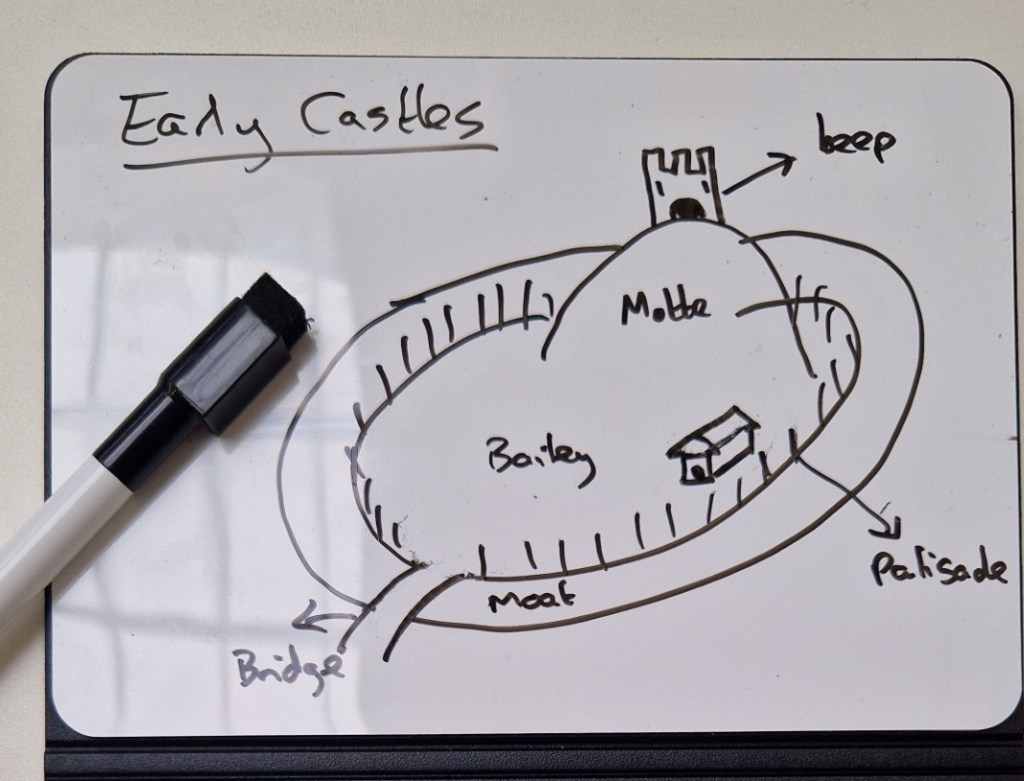
Wow. Mini Whiteboards (MWBs) are back with a vengeance! Having been all the rage 15 years ago, they disappeared from many classrooms for much of the past decade. Now, history departments are being told they have to buy class-sets out of their own budgets, and I’ve heard multiple teachers claim that observer feedback increasingly includes generic comments like ‘you should have used MWBs’.
But, given the speed at which teachers are being asked to adapt practice, how much thought is going into how to use MWBs effectively in history?
Possible – but limited – rationales for using MWBs
As ever, it is worth starting with the rationale behind the pedagogy. There are multiple reasons why MWBs might be used that, I would argue, have limited impact on the pupils’ learning or the quality of teacher assessment.
- Settle a class. Where MWBs are used in this way, the teacher recognises that pupils will arrive at different times and simply wants those that are there to be doing something. Here, it is likely that few pupils will be present long enough to actually finish the task, so MWBs are used because what the pupils are doing is not worth capturing in in a more formal way.
- Assess participation. Where this is the main rationale, as the emphasis is on doing rather than using MWBs to their potential, it is often more likely (in my experience) that the teacher will have asked the pupils to do something that isn’t really appropriate for MWB use – e.g. answer a long list of retrieval questions or write out a paragraph on their little board. As a result, when the pupils hold up their MWBs, the teacher isn’t scrutinising what they wrote, but rather that they put something.
- Promote environmentally-friendly practices. Here, the teacher thinks that capturing the pupil work in their books will not be a responsible use of paper.
All of these are valid reasons for using MWBs – to settle, to assess participation, to be more sustainable. My contention is that unless combined, or superseded, with the aim using MWBs to improve learning and assessment, they will become simply be another pedagogical fad.
The value of MWBs for history teachers
So, what is it about MWBs that offers particular, distinct value? I’d start with the obvious: the teacher gets a comprehensive snapshot of what everyone in the class knows or thinks in relation to a question. If the question is designed carefully to be revealing, and the answers communicated in a way that the teacher can scan and interpret in a split-second, MWBs can allow for teachers to formatively assess far more pupils at once, thus allowing them to identify patterns and respond accordingly.
MWBs can also really help with oracy. They offer a particular opportunity to generate discussion and debate; so necessary in history classrooms. History is by definition argument. We should be harnessing any pedagogical tool that facilitates and encourages argument and debate. By holding up a visible, easily-interpretable response to a thought-provoking, generative question; pupils are committing to a position in front of the teacher and their peers, which means they might be more willing to discuss and defend their argument.
Therefore, I suggest history teachers using MWBs to achieve one or both of the following aims:
- MWBs to provide visible, easily-interpretable and meaningful data.
- MBWs to prompt deep historical thought and purposeful discussion.
In order to achieve these, and focus on the particular benefits that MWBs offer, I’d also establish some rules for particularly effective use:
- Very short (ideally one word or letter) answers
- Only one question answered at once
- All pupils must hold up their boards teacher to see
- For more generative, discussive tasks, all pupils must also hold up their boards for peers to see as well.
Practical implementation of effective MWB use
With this in mind here are some simple suggestions for using MWBs well which meet either one or both of these aims.
- Retrieval questions that require one word answers
This is history so realistically the main categories here are:
- Dates
- Places
- Names
- Events
- Retrieval questions in a multiple choice question (MCQ) format:
When I trained MCQs were seen as unhelpful because pupils can ‘just guess’. However, lots of brilliant history teachers (I’m thinking Paula Worth, Hugh Richards, Jonnie Grande in particular) have shown how MCQs can be written to be super revealing.
The crucial thing to consider is that the incorrect options must be revealing as mistakes.
For instance, if the three MCQ options including three dates, choose two incorrect dates that feature elsewhere in the curriculum. If including three people, choose two incorrect people who are prominent in tangential topics. These means that whatever pupils hold up, it provides meaningful data for the teacher and can lead to any number of responsive actions – probing questions, short re-teaches, targeted circulation during the next activity etc.
- Analytical questions in a MCQ format
This is where MCQs are being used to scaffold and advance historical thinking. The MCQ relates to a question that makes the pupil think hard in a historical way.
These two forms of MCQ can be used in tandem. So the teacher introduces a new source and wants to quickly collect some visible, easily-interpretable and meaningful data. Their use of MWBs might go like this (remember of course that the teacher can ask additional questions throughout and respond to the sorts of responses they are seeing):
- On your MWB what sort of source is this? (e.g. A. Political cartoon, B. Newspaper article, C. Private note)
- On your MWB, who produced this source?
- On your MWB, who is being represented here? Write a name.
- On your MWB, who is being represented here? (This is harder to you can choose between A. B. C.)
- On your MWB, which of these options best sums up what was happening in the world at the time? A. B. C.
- On your MWB, which of these options best sums up what is happening here? A. B. C.
- On your MWB, which of these options best sums how this person here is feeling? A. B. C.
- On your MWB, which of these options best sums what the author was trying to achieve in producing this source? A. B. C.
- Now turn and talk with your partner: what is the message of this source? Teacher gets three pupils to explain their argument.
- On your MWB, which of the three answers we have just heard do you think best summarises the message of the source? A. B. C.
Through this process the teacher has generated visible, easily-interpretable and meaningful data, and made the pupils think hard about a source, while doing so in a way that scaffolds a thinking process they need to go through when encountering a source.
- Generative questions to provoke debate
This is my favourite way to use MWBs – although I haven’t seen much of it this year. The same principles apply that the answers must be visible and easily-interpreted, but they can only really be used at a stage of the curriculum when pupils have enough substantive and disciplinary knowledge to really think about a topic and form their own arguments.
Examples of this being used really well:
- Think about over the depth topic so far, and write down on your MWB which year that we’ve studied has been the most eventful?
- Think about over everything you’ve learnt so far in history, and write down on your MWB which person that we’ve studied would you consider to be the most influential?
- Across these lessons you are answering the enquiry question: ‘how far did the Industrial Revolution improve the lives of ordinary people by 1900?’ At this stage of the sequence, write on your MWB how far you’d argue lives were improved. 0 is lives had got far worse, 5 is they were no better or worse, 10 is they had significantly improved.
As set out earlier, one of the greatest benefits of MWBs is that they can help create a classroom culture where pupils talk purposefully. If they’ve been asked a meaningful question, produced a revealing response, and shared this response visibly with the teacher and peers, there should be opportunities to discuss and debate.
To conclude, I am cautiously excited about the MWB revolution, so long as teachers are given a bit space and support to stop and think: what do MWBs offer that other pedagogies don’t, and how can they be used really effectively in a history classroom? This is not an exhaustive (or particularly ambitious) blog but hopefully it is a helpful starting point.

