

This blog post has been written by Philip Arkinstall, Senior Lecturer at the University of Gloucestershire, former Head of History and Politics.
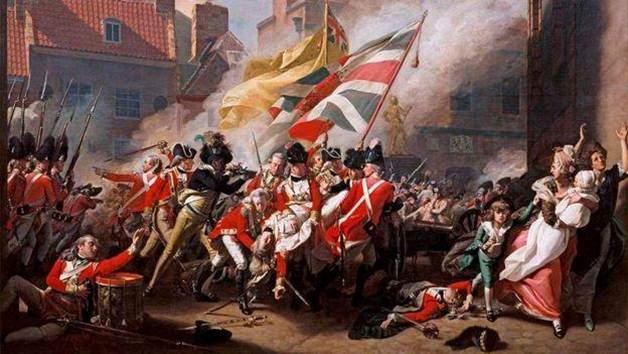
The Battle of Jersey: The Death of Major Peirson, 6 January 1781 by John Singleton Copley
The concept of creating a sequence of lessons about the display of St George Cross flags across the rural town I live and taught in, came from a desire to bring the debate into the classroom. I had seen some interesting things happening across the country – from debates on the television, to protests about the use of the flag, roundabouts being painted and discussions about what it means to be British. I felt particularly engaged with this topic owing to small stickers that were placed at eye level on pedestrian crossings too. So… to work.
I began by going to documents I had saved from my PGCE about teaching difficult histories and then on to the Historical Association’s website. The Teaching Emotional and Controversial Histories (T.E.A.C.H) Report from 2017 was my starting point. The same principles that underpinned the teaching of such topics then still resonated with today.
“History becomes emotive and controversial when people feel injustice, conflict, or unfair treatment in the past”
Key principles:
- History is not neutral – it is interpreted differently
- It is central to understanding the past and engages students with real-world issues
- Enquiry uses evidence informed approach
- Focus on the interpretation, not fixed judgements
- Create the safe classroom
Working alongside trainee teachers on the PGCE at the University of Gloucestershire, we created four lessons which could be used with Key Stage 3 and 4 to look at how to introduce the history of the English and Union flags, before approaching a way of debating it safely in the classroom.
Firstly, we spent some time considering how to build the enquiry to create a safe space for discussing how to engage with conversations about flag flying. Importantly, we wanted to look at the origins and development of flags from the banners of the Chinese Zhou dynasty to the creation of the United Nations flag. Another feature of the lessons was to look at the emotions associated with the use of the union flag and St George’s Flag. This evoked a discussion related to how people felt when the flag was used in marches and demonstrations, versus its use during the Olympic games and football matches. It was interesting to see how this was interpreted. For example, some saw football hooliganism as a problem, but that was juxtaposed against the national women’s team winning the Euros final.
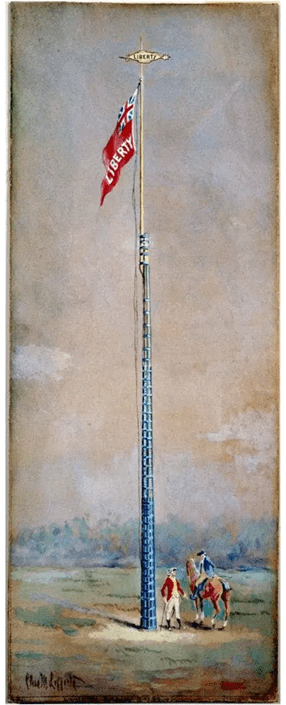
Secondly, we wanted to make links across topics that might be taught including the French and American Revolutions. For me, I really enjoyed teaching British America (1713-83) for GCSE. The clash of American colonists and British troops over the Liberty Pole was one such micro-episode that I wanted to draw attention to. This episode relates so well to the idea of flags being raised and torn down and the anger that invokes.
Coming to the image at the start of this article – The Battle of Jersey. During the American Revolution the French invaded Jersey briefly, which was repelled. The painting helps to illustrate the way that the union flag was used to evoke emotions designed to bring together national unity.
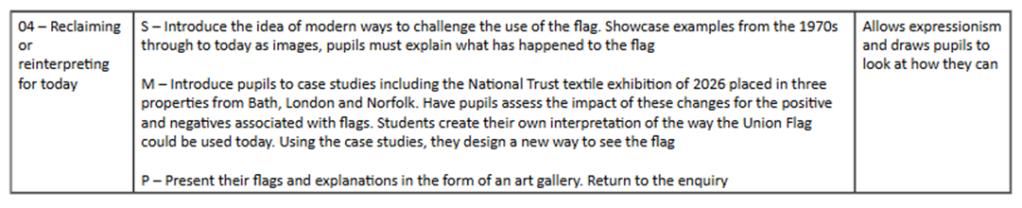
Finally, we wanted to allow pupils the opportunity to ‘capture the flag’ and consider what it should be and for whom in the future. To do this we looked at case studies of countries that have kept the union flag, removed the union flag and those that used it to create something new. The Asafo flags from Ghana in the 1880s are a fab example of how the influence of the union flag formed part of a new type of flag which was their own. This forms part of an exhibition that the National Trust have on at Dyrham Park.
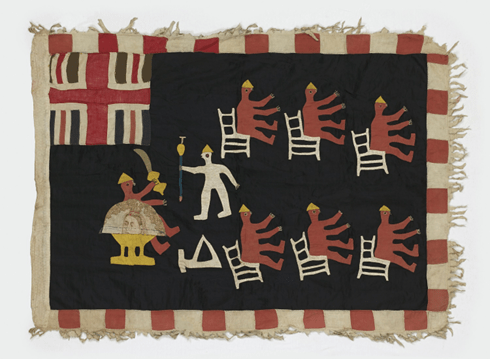
Note the image of Queen Victoria on the golden stool.
The full sequence of lessons are below:
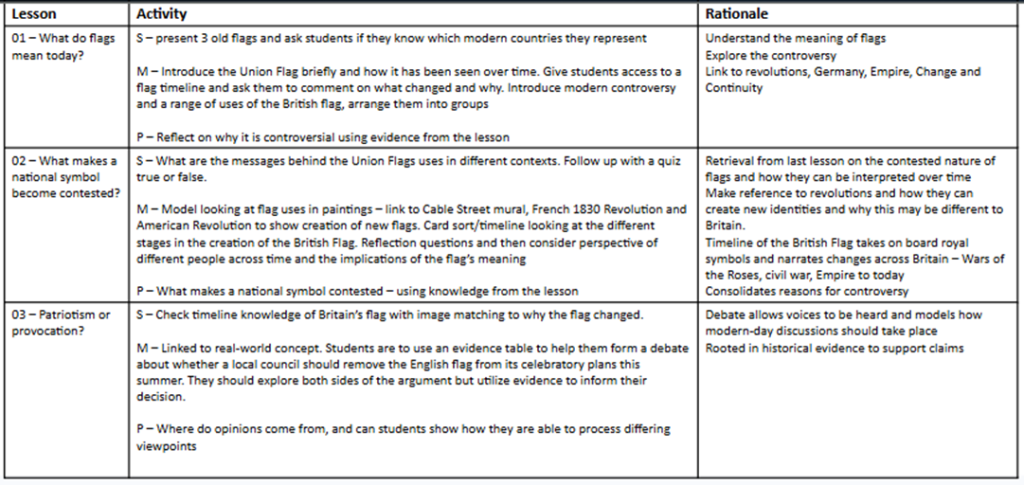
We aim to share the results of the lessons and more details of the resources in a future Teaching History publication, so watch this space!
Having spent time looking at how to address the issues that are coming up across the history community this was my way of taking some ownership of the conversations that could be had in a safe classroom environment.
There are many reasons these issues have surfaced, but for me, staying current with the national debate and feeling empowered to tackle them is an important part of making the subject we teach relevant to all.

