Building a coherent history curriculum: why it matters and how to achieve it

By Catherine Priggs Curricular coherence is a vital element of effective curriculum design. When a curriculum coheres, it unfolds as a logical narrative, ensuring that content is not a collection of isolated topics. In a coherent curriculum, topics are woven together through overarching ideas, reinforcing pupils’ chronological and conceptual understanding. So, what does curricular coherence look like in practice? The power of sequencing A vital … Continue reading Building a coherent history curriculum: why it matters and how to achieve it


Curriculum Review 2024

In September 2024 the Department for Education launched a consultation on the curriculum asking for students, parents, teachers, employers, leaders and experts to share their thoughts on the current model and what a future curriculum could look like. The Historical Association is preparing a response and we wanted to ask you for your help in enabling your students to give their feedback to us on … Continue reading Curriculum Review 2024

Helping Y12 tackle the NEA

Thanks to Sally Burnham for this blogpost. Sally is a history teacher at Carres Grammar School, history tutor at the University of Nottingham and incoming chair of the HA Secondary Committee. Here she shares her depth of experience of supporting A Level students to successfully complete the NEA. I love the History NEA! To me, the NEA is the part of the A Level course … Continue reading Helping Y12 tackle the NEA

Planning enquiries: five rules of thumb

Thanks to Mike Hill, Head of History, Ark Soane Academy, and a member of HA Secondary Committee, for this blogpost to help with the planning of enquiries. Over the last term, I planned seven new enquiries and I am currently working on an eighth. I feel out of breath typing this. Planning these enquiries has sometimes felt like trial by ordeal, but it’s also been … Continue reading Planning enquiries: five rules of thumb

Assessment at KS3 in History

Thanks to Martyn Bajkowski of Pleckgate HS and HA Secondary Committee for this blogpost. Martyn reports on the work he, and his department, have been doing to improve their KS3 assessment. Like many of you I have carefully considered over recent years what I wanted our approach at assessment to be at KS3 in our department. Following my session at the HA Conference this May … Continue reading Assessment at KS3 in History

This blogpost isn’t for you; what your line manager needs to know about history

Thanks to Catherine Priggs, Assistant Headteacher T&L, Dr Challoner’s Grammar School and member of HA Secondary Committee for this week’s blogpost. In it Catherine explains how to work with senior leaders to ensure that they have the knowledge they need to support history teaching and subject leadership. Curriculum leadership needs our attention. In the face of non-specialist teaching due to a recruitment and retention crisis, … Continue reading This blogpost isn’t for you; what your line manager needs to know about history

Where do marks on KS3 assessments come from?

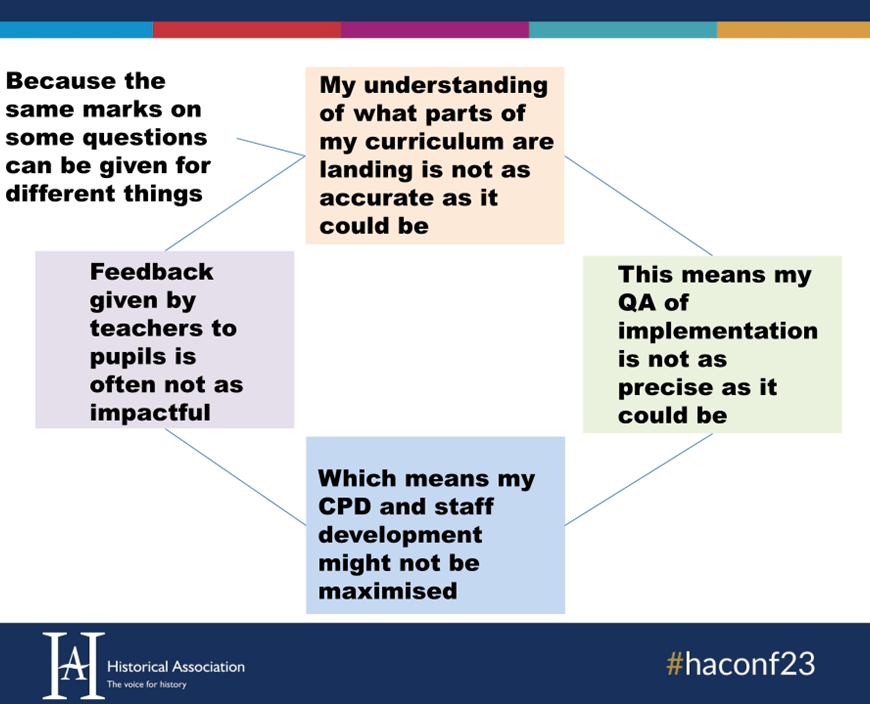
Thanks to Martyn Bajkowski, Head of History at Pleckgate School and member of Secondary Committee, for sharing work on assessment at Key Stage 3. Martyn shares how his department have read, thought and discussed their way to a manageable system that is focused on secure historical learning. Pupils find it engaging and it is providing the department with useful data to use to work on … Continue reading Where do marks on KS3 assessments come from?

Curricular implementation at Key Stage 4: Anatomy of a GCSE History Unit.

Thanks to Hugh Richards, Head of History at Huntington School and course leader of the HA’s Subject Leader Development Programme, for this blogpost. In it Hugh walks us through the process of planning a GCSE History Unit. From that he draws out GCSE planning principles. This blogpost is useful for anyone also planning GCSE units and to discuss in departmental CPD. I have recently planned … Continue reading Curricular implementation at Key Stage 4: Anatomy of a GCSE History Unit.

Some thoughts on responding to results: a guide for new (or nervous!) Subject Leaders of History

In this blogpost Hugh Richards shares his experience of results’ days. Hugh is Head of History at Huntington School in York and the leader of the team of SLs who work on the HA’s Subject Leader Development Programme. Firstly, I am no expert on data. I am an experienced head of department, but I am not claiming any particular authority, just sharing my approach in … Continue reading Some thoughts on responding to results: a guide for new (or nervous!) Subject Leaders of History

The return to formal assessment at KS3

Richard Kennett (@richkbristol), of Gatehouse Green Trust in Bristol, shares recent rethinking of KS3 assessment in his school in response to recent discussions on history edutwitter. This may be incredibly obvious to many of you but given the number of tweets I keep seeing about assessment I thought I would share what we have been doing and thinking at my school in Bristol. I am … Continue reading The return to formal assessment at KS3